


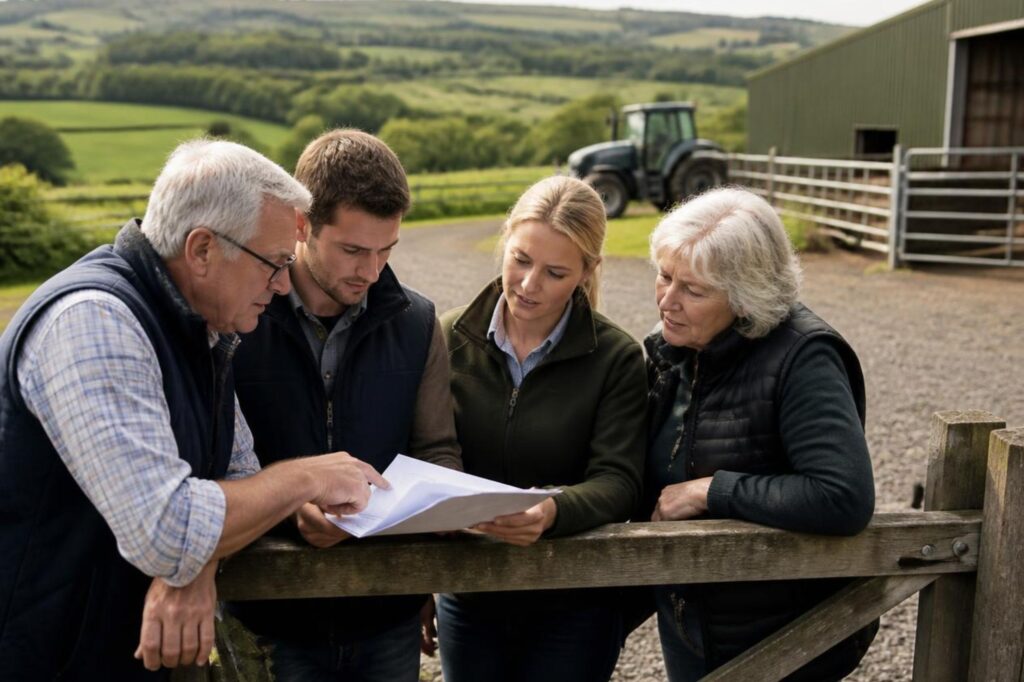
In this blog we talk about farm partnerships, why it is important to put in place a partnership agreement and how to avoid disputes.
Traditionally, farms have been family affairs, started many years ago by great great grandparents, and continued down the generations.
In the past, it might have seemed disloyal, or imply a lack of trust, to insist that the farming business arrangements were set out in a legal document. In the modern age, it is not only commonplace but essential to have a written agreement between the individuals owning and operating the farm.
That has become more pressing since April 2026. The changes to Agricultural Property Relief and Business Property Relief have made how a farm partnership is structured, and how it holds its assets, directly relevant to the inheritance tax the next generation will face. A well-drafted partnership agreement is now not only a tool for avoiding disputes, but an important part of protecting the value of the farm as it passes on. We look at that below.
Farm partnerships
Focusing here on family farms, it is important to have a short but flexible agreement in place to reflect the long-term interests of the farming family and document how the business is to be passed on through the generations. It is highly likely that the document will be formalising an existing informal partnership.
Using a partnership structure to run a business is quite outdated and is generally only seen in professional practices or farms. But wherever two or more people carry on business together with a view to making a profit, they will be operating in partnership if there is no other legal structure put in place, and without a written agreement their relationship will be governed by the Partnership Act 1890.
Unlike a limited company or a limited liability partnership, there is no separate legal entity to a partnership, and partners can be bound by what other partners do. This is just one of the many reasons that a formal partnership agreement is the best option.
Farm partnerships have to deal with a number of specific issues, such as the treatment of valuable assets, land ownership and succession planning.
Disputes can arise when farmers either fail to obtain any advice, fail to get good advice, or fail to get their advisers to work together. Ideally, the solicitor should work in tandem with the farm’s accountant and land agent to make sure that issues of land, taxation, accounts and succession planning are all dealt with properly. That joined-up approach matters more than ever under the new tax regime, where the way land is held within the partnership can affect the relief available.
Potential farm partnership issues to be considered
Just some of the farming partnership issues that need to be considered are:
- What happens if a family member dies, is incapacitated, wants to retire or gets divorced?
- Will the partnership continue?
- How will the interest of the partners be valued?
- Can new partners join the partnership?
- How will a leaving partner be paid out?
- How are disputes to be dealt with?
Disputes can arise in relation to property, capital contributions, profit shares, employees, confidentiality and competition, succession planning and the expulsion of unwanted partners.
If there is no agreement, on the face of it partners are to share profits equally, and when issues like the above arise the partnership will have to fall back on the 1890 Act and look at the previous history and accounts of the partnership.
It is also important to document how often meetings take place, to make sure they are minuted, to keep accounts, to specify when partners are allowed to withdraw profits (“drawings”), and, if disputes do arise, how those disputes will be dealt with.
Retirement, succession and capital accounts
Bringing the next generation in, and easing the older generation out, is one of the most important things a partnership agreement can address, and one of the most commonly overlooked. Clear provisions for retirement and for how and when an outgoing partner’s interest is paid out give the family certainty and help avoid the kind of disagreement that can be so damaging on a farm.
The tax changes give this fresh significance. How the older generation’s capital accounts are structured, and how they are phased out over time, can have a real bearing on the inheritance tax position. Planning this carefully, with your solicitor, accountant and land agent working together, allows the transition to happen in an orderly way rather than being forced by an unexpected event or an unexpected tax bill.
Resolving disputes
Resorting to court action is not always advisable. It can be costly, it can result in loss of income and productivity on the farm, and it creates family turmoil, emotional distress and even loss of reputation in the industry.
There are other options to consider, such as arbitration, mediation or expert determination, each of which can offer a less costly and less adversarial route than court.
Above all, whatever the size and type of the farming operation, and the roles of the different family members and their contributions, it is vital to keep communication going, and that will be helped significantly by having a formal document, a partnership agreement, to refer to.
How we can help
If you would like to discuss farm partnerships, whether to create one for your business or because an issue has arisen within your partnership, please get in touch with Helen Brown.
You may also be interested in our upcoming seminar at Lainston House on 15 October 2026, where our agricultural team and fellow professional advisers will explore partnership structures, succession and the multi-generational transition of farms and estates in more detail.
You can also visit our Agricultural Land, Farms & Estates page to find out more about all the services we can help you with.
We publish blogs and social media posts to give a general overview of legal and commercial issues, relevant at the time of publication, which we hope you will find interesting. Please note that legal rules often change depending on the specific facts of a situation. The law also changes over time following changes in legislation or new court cases. We do not actively update our blogs or posts once they are published to reflect changes in the law.
As such, our blogs and posts are not intended to advise you on the law and must not be relied upon as legal advice. If you require advice on a particular issue then please contact us and we will be pleased to help.