


Data Subject Access Requests
DSARs are time intensive and the deadline doesn’t move. Our AI-based software, powered by Smartbox.ai, and our expert employment lawyers take the strain off your team, from the first document to the final response.
CLOSE 

Under the UK GDPR, employees have the right to submit a data subject access request (DSAR), requesting access to copies of their personal data. We understand that, given the volume of documents involved, these requests can be very time intensive to manage. One of the main challenges that employers face is how they are going to allocate resources to respond to a DSAR. As a firm we are seeing increasing numbers of DSAR’s being submitted, placing pressure on organisations to effectively manage and respond to requests promptly.
Paris Smith LLP has AI-based data management software which is specifically designed to enable us to manage the process for you and to help you respond to DSAR’s. Using this software, we can have complete oversight of the DSAR review process for you, saving you time, resources and improving accuracy. We can also provide legal advice on your obligations and advise on any tricky queries arising from the documents, or guidance on any exemptions that may apply.
Book a free demoNo obligationCall us023 8048 2370Email usinfo@parissmith.co.uk
Responding to a Data Subject Access Request
The usual time limit for responding to a DSAR is one calendar month of receipt of the request. Whilst that may seem like a long time, the volume of work involved means that it will be important to plan timings carefully as soon as a request is received.
Case study
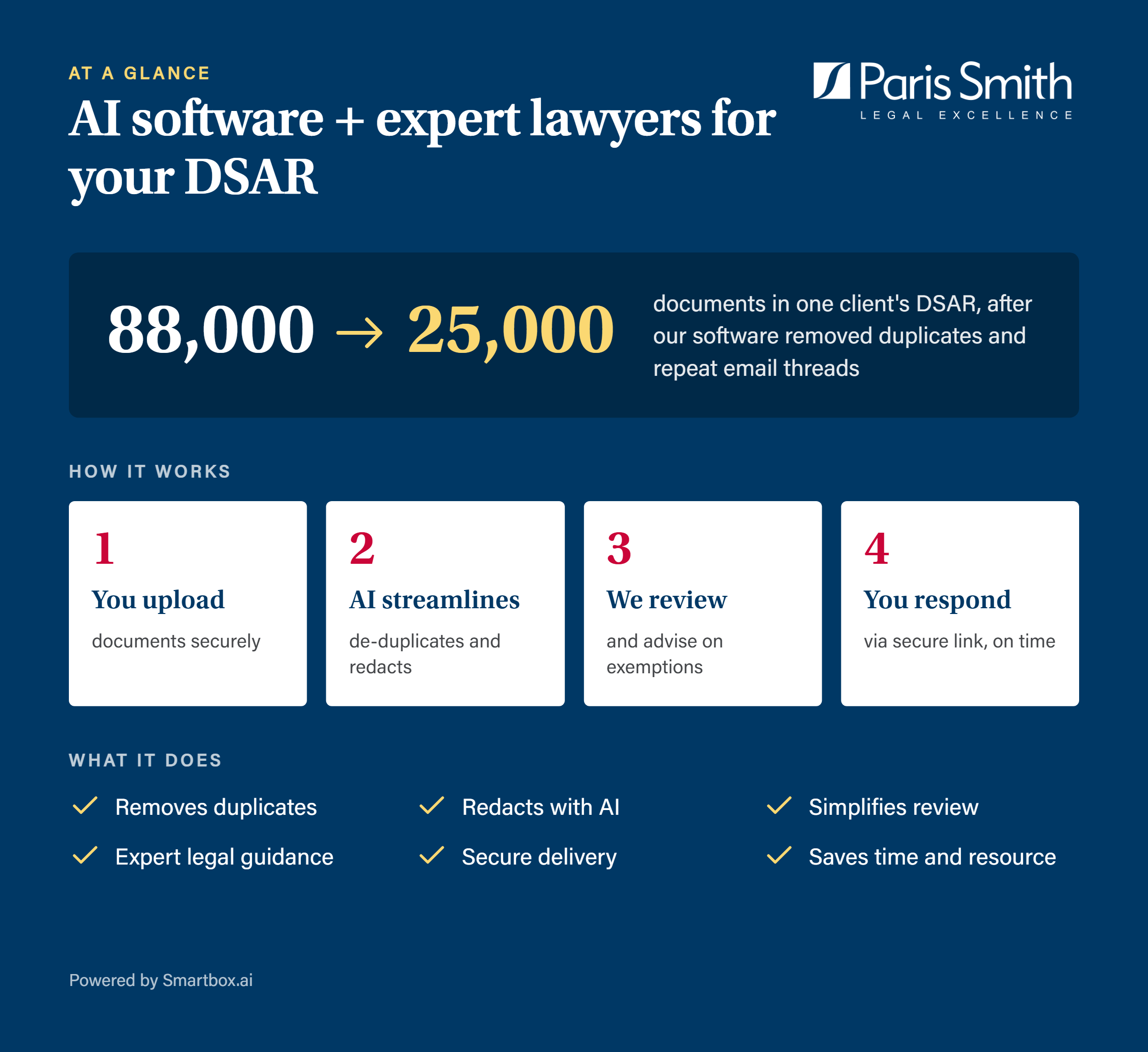
A client received a data subject access request from an employee who was still in their probationary period. Around 88,000 documents were identified as potentially relevant. Using our intelligent software, we reduced this to approximately 25,000 documents by removing duplicates and shorter email threads. We then applied the appropriate redactions, which made the review process far more manageable for our client.
How we work with you
Paris Smith is based in the South of England and acts for businesses and organisations across the UK. Technology allows us to provide a high level of service wherever you are based, and we can advise you:
- by telephone
- through online appointments
- in face-to-face meetings
We will discuss how you would prefer to be contacted during our first conversation.
How we can help using our intelligent software
Using our secure intelligent software, we are able to:
Streamline documents
CLOSE

Streamline documents
Efficiently streamline large numbers of documents by removing duplications and repeated email threads in the data uploaded.
Apply appropriate redactions
CLOSE

Apply appropriate redactions
Apply appropriate redactions to the documents to remove third party data using the AI software.
Review process
CLOSE

Review process
Undertake a manageable review process for you.
Provide guidance
CLOSE

Provide guidance
Advise on tricky queries relating to documents and provide guidance on any appropriate legal exemptions which may apply.
Secure link
CLOSE

Secure link
Provide a secure link to the fully analysed and redacted documentation in compliance with your legal obligations and the Information Commissioner’s Office (ICO) guidance.
Case Study
CLOSE

Case Study
“Our client received a DSAR from an employee within their probationary period. Despite their short length of service, they identified approximately 88,000 documents which they believed amounted to the individual’s personal data.
Using our secure software, we were able to initially reduce this data from 88,000 documents to 25,000. We did so by removing duplicate emails and documents. It is very common for several individuals to have copies of the same emails or attachments in their inbox, which would all be captured in the DSAR. The software will identify this and remove the duplicates. We also used the software to reduce email threads. This means that, where there are several emails exchanged in a conversation, the software will locate the longest email chain and remove the shorter threads. From there, we could apply redactions using the AI software and undertake a much more manageable and efficient review of the remaining data”



How we’ve helped our clients


Data Subject Access Requests Resources


Videos
Data Subject Access Requests – 5 Top Tips for Employers
CLOSE
Data Subject Access Requests – 5 Top Tips for Employers
Back
to Employment
 Back
to Employment






Introducing your key contacts


KEY CONTACTS
Data Subject Access Requests Resources
Videos
Data Subject Access Requests – 5 Top Tips for Employers
CLOSE
Data Subject Access Requests – 5 Top Tips for Employers
CLOSE